Crown Meadow First School & Nursery Together We: Dream, Believe, Achieve and Succeed
English
Our Reading Approach
Crown Meadow benefits greatly from a well sequenced, ambitious reading curriculum. Each cohort has a suite of core texts that form the depth study for the academic year.
These texts represent a promise that our school is committed to the study of literature throughout a pupil’s learning journey. The texts have been mapped carefully to ensure a breadth of experiences, authors, texts and themes across the Primary years.
In addition to these texts, there are core poems that each year group will study in detail and other texts are studied within the curriculum.
This reading spine represents the core texts for depth study only. The literature spine has been harmonised with the wider curriculum, where appropriate. Changes to the long-term sequence have been reflected for the academic year 2025-26.
CUSP Reading includes elements of choice for each year group. These modules give our teachers the opportunity to substitute a text based upon the needs of a cohort or to reflect our school context. This is done without compromising the structure or quality of the Reading units.
Teachers and leaders carefully track any changes that are made to ensure that the curriculum retains balance over time and that any changes are reflected in the whole school curriculum documentation. The expectation is that most schools will adhere to the original literature spine.

Our Writing Approach
The primary goal of the National Curriculum for English is to help children communicate confidently and effectively. At Crown Meadow we use CUSP English and our Writing curriculum seeks to achieve this through high-quality structures, enabling meaningful engagement.
CUSP Writing provides our teachers with the tools to explicitly teach essential writing skills. Recognising the extensive subject knowledge needed for the Primary Writing curriculum, CUSP helps our teachers to sequence this knowledge, allowing our staff time to enhance their expertise and ensure lessons cater to all pupils.
Our CUSP writing approach integrates key writing knowledge and competencies, using cognitive science insights to embed learning in long-term memory. Children need a deep understanding of writing elements to produce high-quality work independently. By breaking down broader National Curriculum objectives and encouraging systematic revisits in various contexts, we help our children to achieve flexible and confident application.
Cognitive science shows that multiple exposures to key concepts are necessary for retention and some writing curriculum concepts are more valuable than others. CUSP Writing adopts a Reduce and Revisit model, limiting the number of text types studied to emphasise mastery of a few carefully selected ones, ensuring balanced progression throughout the children’s education at CMFS. For instance, Key Stage 1 prioritises poetry to foster playful engagement with language, while Key Stage 2 focuses on formal text types to prepare students for future writing.
Our children study each text type twice a year: Block A introduces the text type and its concepts, while Block B allows for reflection and independent, creative development as their confidence grows. The long-term sequence aligns with the broader curriculum, creating opportunities for pupils to write about concepts they’ve encountered, reducing cognitive load and enhancing focus on the writing process.
High-quality models are central to the CUSP Writing curriculum. They exemplify key concepts and serve as worked examples for applying those concepts in context, providing our children with a clear vision and structure to strive toward.
Each CUSP Writing unit begins by identifying the context, purpose, and audience for writing. Children thrive when they understand these elements, especially when the audience feels "real" and they are personally invested. They engage deeply with high-quality models that illustrate the concepts they will learn, allowing teachers to focus on these during explicit instruction. This familiarity with the model text's language and structure prepares pupils for their own writing.
In Block A, teachers use the model text's structure to guide pupils in planning their own version in a different context. By Block B, some scaffolding is reduced, encouraging greater independence in practice.
We plan for our children to spend as much time "talking the text" as writing it. They should articulate and experiment with each sentence before writing, ensuring clarity in their intentions. Finally, teachers model the editing process for various purposes, prioritising secretarial editing and meaning before exploring editing for impact.
CUSP priorities vocabulary development and allows all children to aim high. Each Writing unit includes essential words for children to learn through explicit instruction. Teachers can also identify additional vocabulary relevant to their specific cohorts to ensure success in each lesson.
CUSP Spelling
In order for our approach to the teaching of spelling to align to other aspects of the English curriculum, we have made the decision to move away from Spelling Shed and follow the CUSP approach to spelling from September 2025.
CUSP Spelling has been purposefully built around the principles of evidence-led practice. This is to ensure that pupils acquire deep knowledge about the English spelling system and that this learning endures. The curriculum is written cumulatively to allow teachers to move backwards and forwards depending on the starting points for their pupils. Fully resourced, CUSP Spelling is both teacher-facing and pupil-facing, building consistency in how Spelling is taught across the school and ensuring that all teachers have the deep subject knowledge required to teach the statutory content of the National Curriculum for Spelling.
CUSP Spelling is a balanced approach, drawing together knowledge about phonics and vocabulary and pairing this with pattern seeking and reasoning.
The CUSP Spelling curriculum is organised into 2-week blocks, with each block covering a particular set of key concepts, including spelling patterns, etymology and morphology and reasoning about spelling. These blocks are made up of three lessons per week: 2 x 15 minute (minimum) discrete Spelling lessons and 1 x Spelling starter for the final Writing lesson of each week.
Systematic revisiting and incremental progression is inherently written into the long-term sequence with short lessons taught across the week within each unit from Year 2 to Year 4. Teachers are encouraged to use the dictation element and handwriting practice to maximise the time available for the development of vital transcription skills.
Handwriting
At Crown Meadow, in the Early Years, pupils are taught to print as part of our Early Writing approach. Teaching handwriting through the Essential Letters and Sounds (ELS) programme involves integrating letter formation directly into daily phonics lessons using specific rhymes and mnemonics.
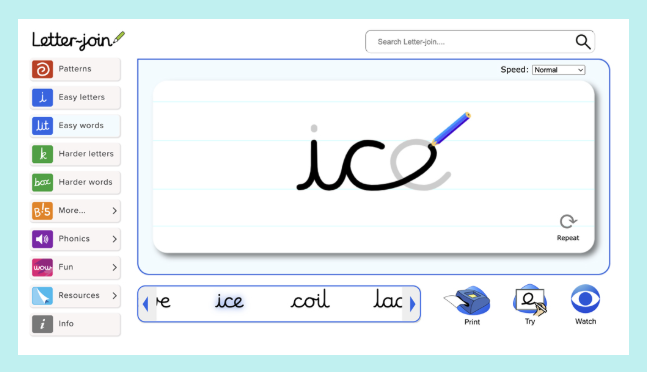
As the children progress up the school, we introduce Letter-join, which offers a wealth of handwriting resources, including interactive features for direct teaching from our Interactive White Boards and iPads as well as worksheets that support the practice of cursive script.